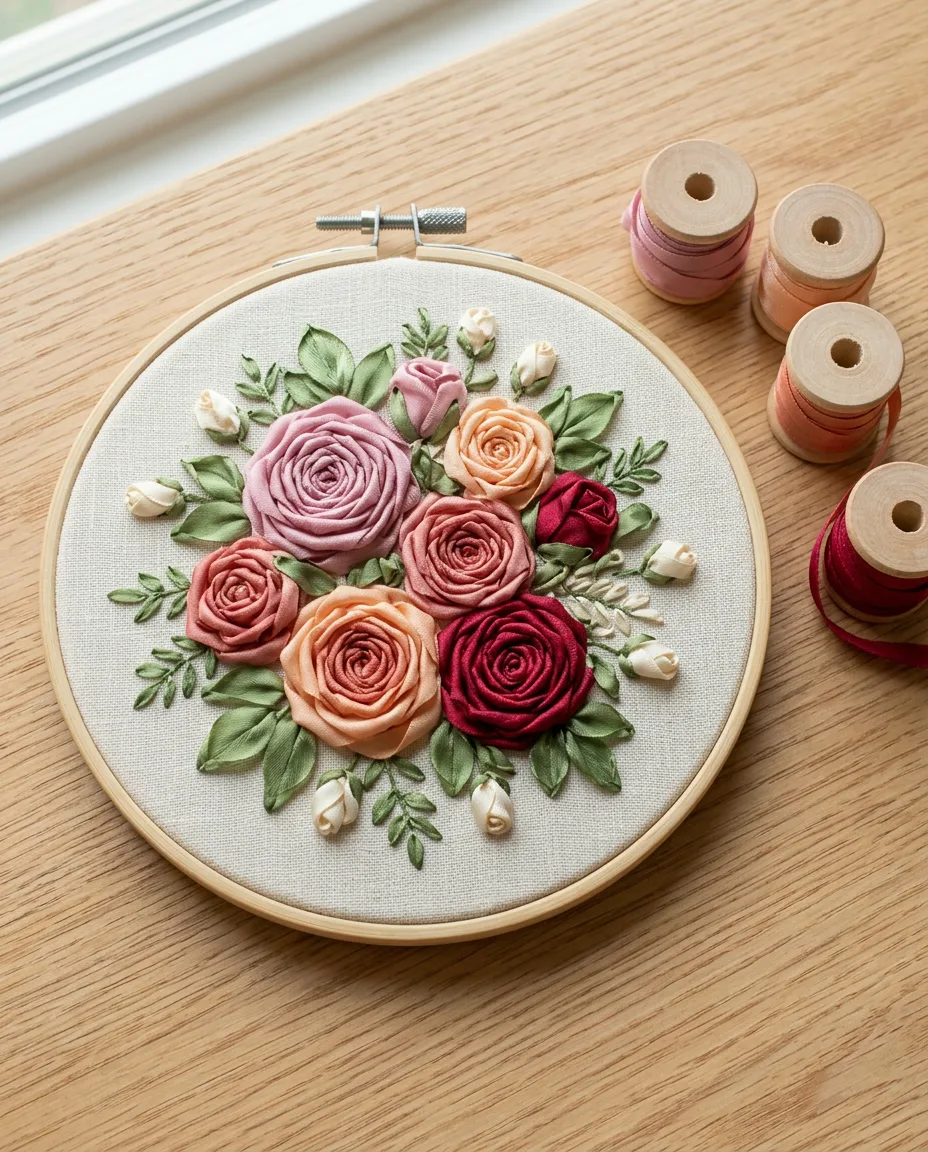
Five spokes of floss and about 12 inches of silk ribbon make one rose. That is the whole recipe. A finished spider web rose sits roughly half an inch across and stands a few millimeters proud of the fabric. It takes around fifteen minutes once your hands know the path. Most of the work belongs to the ribbon. As you weave it around the spokes, it folds and twists on its own, and those twists read as petals. Your job is mostly to stay out of its way.
Gather this before you start:
How to stitch a spider web rose
Set up the hoop first. The fabric should be tight enough to tap like a drum, because the spokes need a firm base to hold the weaving. Then work these steps for each rose.
- Draw a circle about 1/2 inch (12 mm) across and mark its center with a dot. Mark five evenly spaced points around the edge, like the points of a star.
- Thread the size 7 needle with 2 strands of floss. Six-strand floss pulls apart into single threads, and two of them together make a spoke that is strong but thin enough to vanish under the ribbon.
- Stitch five straight stitches, each from an outer mark down into the center dot. Each spoke is about 6 mm, just under 1/4 inch, long. Tie off on the back.
- Cut 12 to 14 inches of deep rose ribbon. Thread it through the chenille needle, then pierce the short tail about 1/4 inch from its end and pull the long end. The ribbon locks onto the eye and stops sliding off.
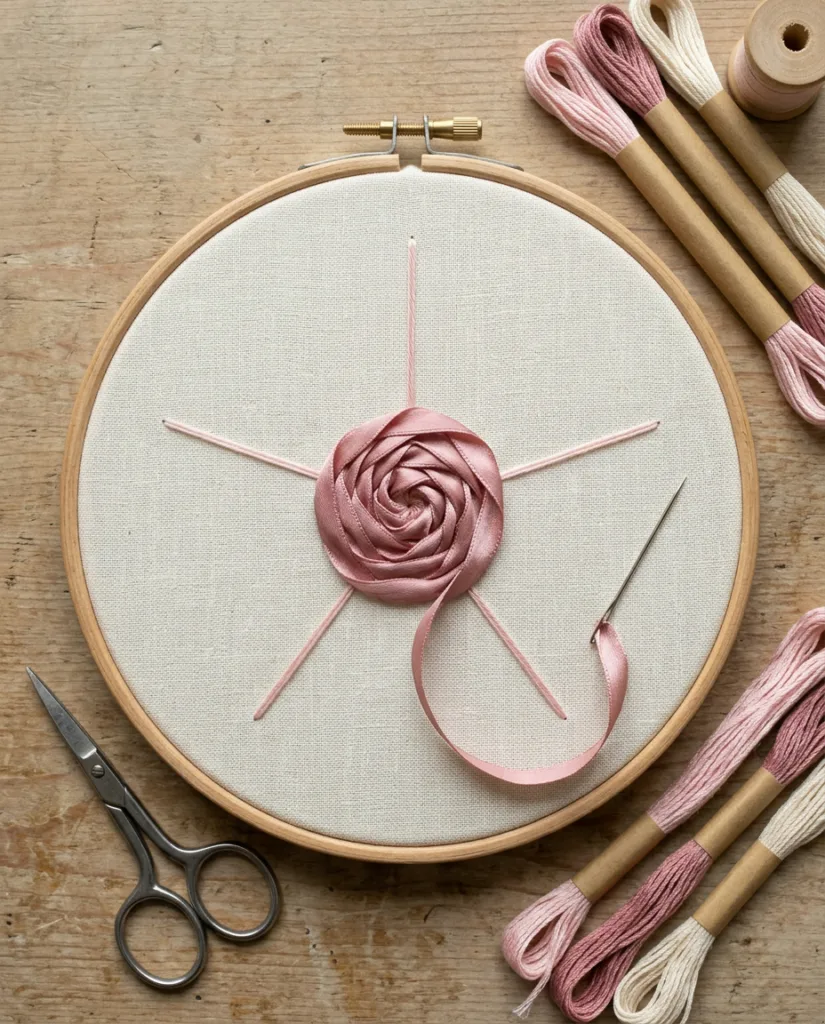
- Bring the ribbon up from the back right next to the center, between two spokes.
- Weave over one spoke and under the next, circling outward. The needle passes only under the spokes and never through the fabric. Lead with the eye end of the needle so it slides over the spokes without splitting them.
 Save
SavePink ribbon woven halfway around five floss spokes for a spider web rose - Let the ribbon twist as it goes. Each twist becomes a curled petal edge, so resist the urge to flatten it.
- Keep the ribbon loose. Pull only until it rests on the round before it.
- Weave until no floss shows at the outer edge, usually five or six rounds. Take the needle down to the back, tucked under the last petal.
- Stitch the ribbon tail to the back of the fabric with one strand of matching floss, then trim it to 1/4 inch.
Five spokes matter more than it looks. An odd number means each new round falls over the spokes it went under last time. With six spokes the weave repeats itself, and the rose flattens into a disk.
Shading the petals from dark to light
Real roses are darkest in the middle. Copy that. Weave the first two or three rounds with the deep rose ribbon, then bring it to the back and switch to blush for the outer rounds. The pale ribbon starts next to where the dark one ended, and the change reads as petals opening.
One ribbon throughout is the other option, relying on twist alone. It looks softer. Most people end up preferring the two-tone version on light fabric and the single color on dark grounds, where the contrast gets lost anyway.
Size changes the mood too. For a large, full rose, draw a 3/4 inch circle, lengthen the spokes to about 9 mm and switch to 7 mm ribbon with a size 18 chenille needle. The wider ribbon folds in bigger, looser curls.
Ribbon stitch leaves
Leaves come from ribbon stitch, and the stitch only works if you go slowly. Thread green ribbon on the size 20 chenille needle and lock it the same way. Bring it up at the base of the leaf, right against the rose.
Lay the ribbon flat along the fabric in the direction the leaf should point, about 10 mm (3/8 inch). Hold it flat with your thumb. Now push the needle down through the middle of the ribbon itself at the leaf tip, and through the fabric below.
Pull very slowly. The ribbon edges roll inward and the tip curls into a point. Stop the moment you see that curl. One more tug and the whole leaf disappears through the hole.
 Save
SaveTwo or three leaves per rose is plenty. Angle them outward from the rose at slightly different lengths, from about 8 mm to 12 mm, so they don’t look stamped.
Fill the gaps with buds and stems
Only full roses in a bouquet look heavy.
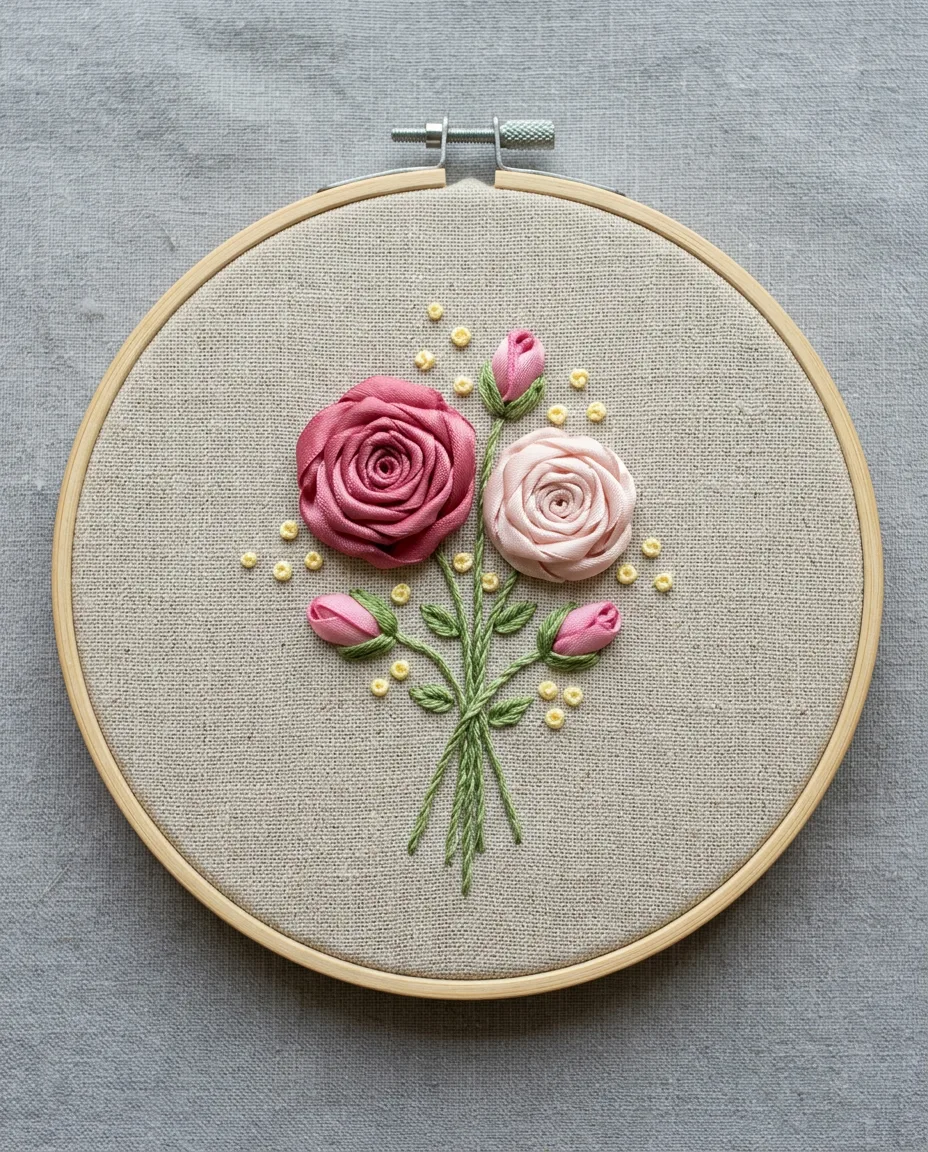
Mix sizes instead. Pair one large open rose with a smaller one, then tuck two or three buds around them.
Each bud is two short ribbon stitches side by side, each about 5 mm long, pulled gently so they stay plump. Add a fly stitch around the base in 2 strands of green floss for the little cup of leaves that holds a bud. Stems in stem stitch, 2 strands, with stitches about 3 mm long, link everything together. Stem stitch is a line of slanted stitches that each come up halfway along the one before, which gives a twisted, rope-like line.
Tiny ribbon French knots fill the gaps between flowers. Wrap the ribbon once around the needle, not twice, since ribbon is much bulkier than floss. The French knot guide covers the floss version in detail, and the motion is the same.
 Save
SaveWhy a rose goes flat
Tight ribbon causes most flat roses. When the weaving is pulled snug, the ribbon lies smooth against the spokes and the petals disappear. It happens gradually. Each round gets pulled a touch firmer than the last, because your hand wants the weave to look neat. Loosen up and let the ribbon puff between spokes. If a round already looks flat, ease it back using the needle’s eye end before weaving the next one.
But a rose can also fail at the spokes. Spokes stitched loosely let the ribbon slide around, and the rose drifts off center. Pull them snug, since they are the one part that should be tight. Spokes that are too long are a separate problem, because the ribbon runs out of room to bunch and each round lies flat.
Frayed ribbon is the other common trouble. Silk ribbon wears a little every time it passes through fabric. Keep pieces to 14 inches or less, and on tightly woven fabric open the hole first using a larger needle.
Ribbon roses on any fabric
Linen and quilting cotton are the easiest start. The fabric guide explains why a medium, even weave behaves best. Canvas and denim work well too, though you need the size 18 chenille needle to push through them. Felt holds ribbon beautifully and needs no hoop at all.
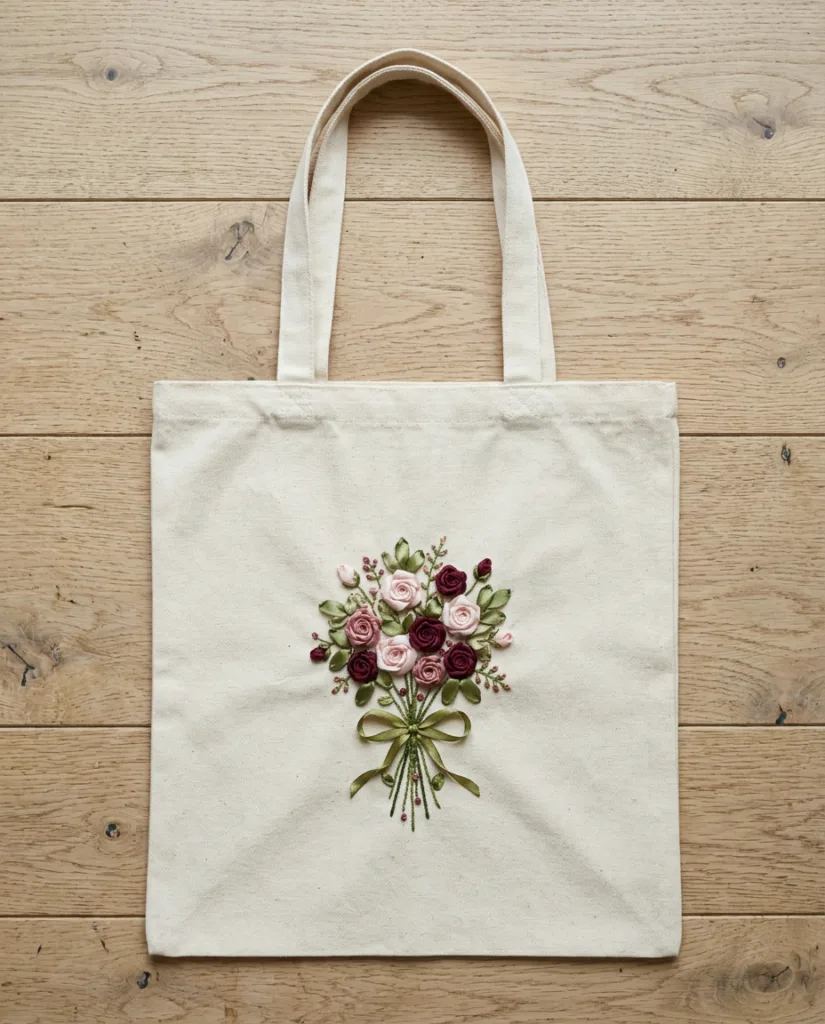
On a tote bag or jacket, place the roses away from straps and seams. Anything that rubs will crush the petals within a week. Hoop the garment’s own fabric around the design area, or skip the hoop on thick canvas and hold it flat on your lap.
 Save
SaveStretchy knits are the exception. Silk ribbon on a T-shirt pulls the fabric out of shape, so back the area with a soft fusible stabilizer first. Iron-on stabilizer needs a hot iron, so keep children clear while you press it.
Washing and reviving ribbon work
Hand wash only. A washing machine crushes silk petals flat and can pull the ribbon through to the back. Swish the piece in cool water with a little mild soap and roll it in a towel to press the water out.
Never iron over the roses. Lay the piece face down on a thick folded towel and press the fabric around them from the back. The towel gives the petals somewhere soft to sink into. Use a medium heat setting with no steam for silk. A crushed rose often comes back if you hold a steaming iron about an inch above it for a few seconds. Then nudge the petals up with the tip of a tapestry needle, the blunt needle used for ribbon.
Once one rose works, a bouquet is just repetition. A single rose on a denim pocket makes a fast first project, and the jeans embroidery guide shows how to hoop inside a pocket without catching the back layer.