Short answer
Quilting cotton or a cotton-linen blend is the best fabric to learn on, because both are stable and hold stitches flat. Skip stretchy knits like T-shirt jersey until you can fuse a stabilizer to the back.
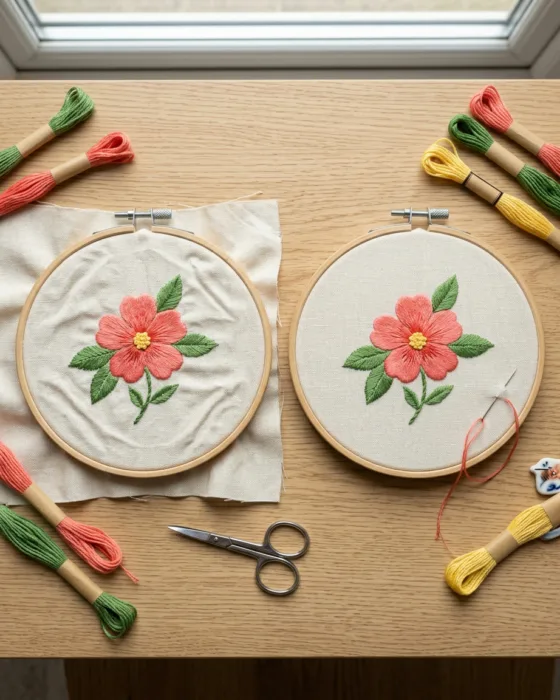
The flower looked perfect in the hoop. Every petal lay flat. Then the hoop came off, the soft T-shirt fabric sprang back, and the whole design crumpled into ripples that no iron could press out.
Nothing was wrong with the stitching. The fabric was the problem. Knit jersey stretches in every direction, and without a support layer behind it, it pulls away from the thread the moment it relaxes. Pick a stable woven fabric instead and the same flower stays flat for good.
Below is every common hand embroidery fabric, what it suits, and when it needs help.
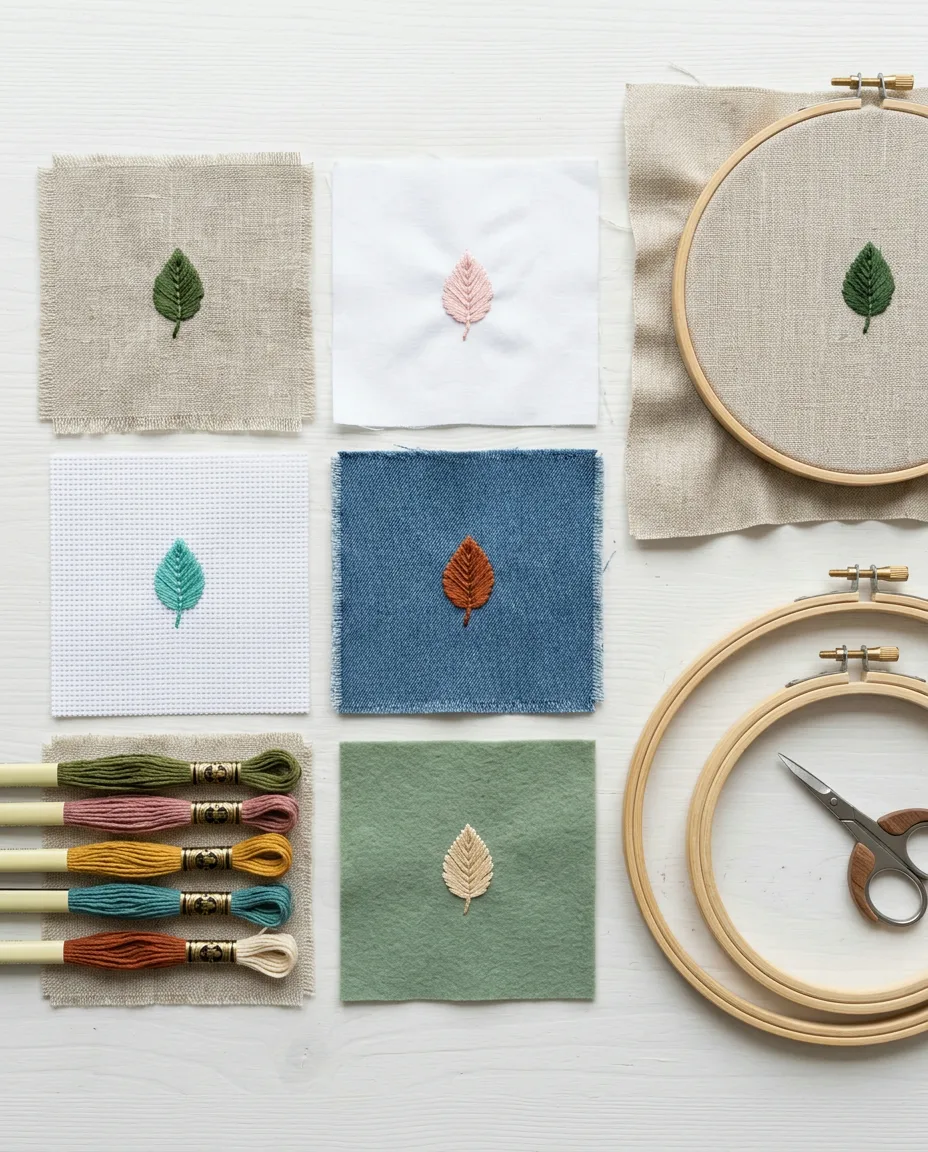
Seven fabrics side by side
Weight is how heavy a fabric is for its size, given in ounces per square yard (oz) or grams per square meter (gsm). Count is how many threads, or holes, fit in one inch. Both numbers are usually on the bolt label or the shop listing.
| Fabric | Typical weight or count | Best for | Needs stabilizer? |
|---|---|---|---|
| Quilting cotton | 4 to 4.5 oz (135 to 150 gsm) | Learning and samplers | Only under dense fill |
| Cotton-linen blend | 5 to 6 oz (170 to 200 gsm) | Hoop art and most projects | No |
| Medium-weight linen | 5 to 7 oz (170 to 240 gsm) | Flowers and table linens | No |
| Aida cloth | 11 to 18 count, 14 most common | Cross stitch and counted work | No |
| Denim | 10 to 14 oz | Jeans and jackets | Only if it stretches |
| Wool-blend felt | About 1 mm thick | Ornaments and bookmarks | No |
| Knit jersey | 4 to 6 oz, stretchy | T-shirts, once you can stabilize | Yes, always |
Start on quilting cotton or a cotton-linen blend
Both are tightly woven and stable. The threads cross at even right angles and stay put, so the needle lands where you aim it. Neither stretches when you pull the fabric tight in the hoop.
Buy a light solid color, like cream or pale gray. Light fabric shows your drawn pattern lines clearly. And a solid color hides nothing, so you can see whether your stitches are even.
Quilting cotton is cheap and easy to find, which makes it the best fabric for a first practice piece. Its one weakness is thinness. Dark floss can show through from the back, and a large satin stitch area can pull it into waves. Fix both by hooping a second layer of plain white cotton muslin behind it and stitching through the two layers as one.
A cotton-linen blend, often around 55 percent linen and 45 percent cotton, is the upgrade. It has the texture of linen with the steadier weave of cotton. At 5 to 6 oz, it holds satin stitch without a backing layer. The beginner’s guide to hand embroidery lists the rest of the day-one kit to go with it.
For either fabric, use 2 strands of six-strand floss (floss is sold as six thin threads twisted loosely together, and you separate out the number you need). Pair it with a size 7 embroidery needle and a 6 inch hoop. Keep stitches about 3 mm long, just over 1/8 inch.
Skip stretchy knits until you can stabilize them
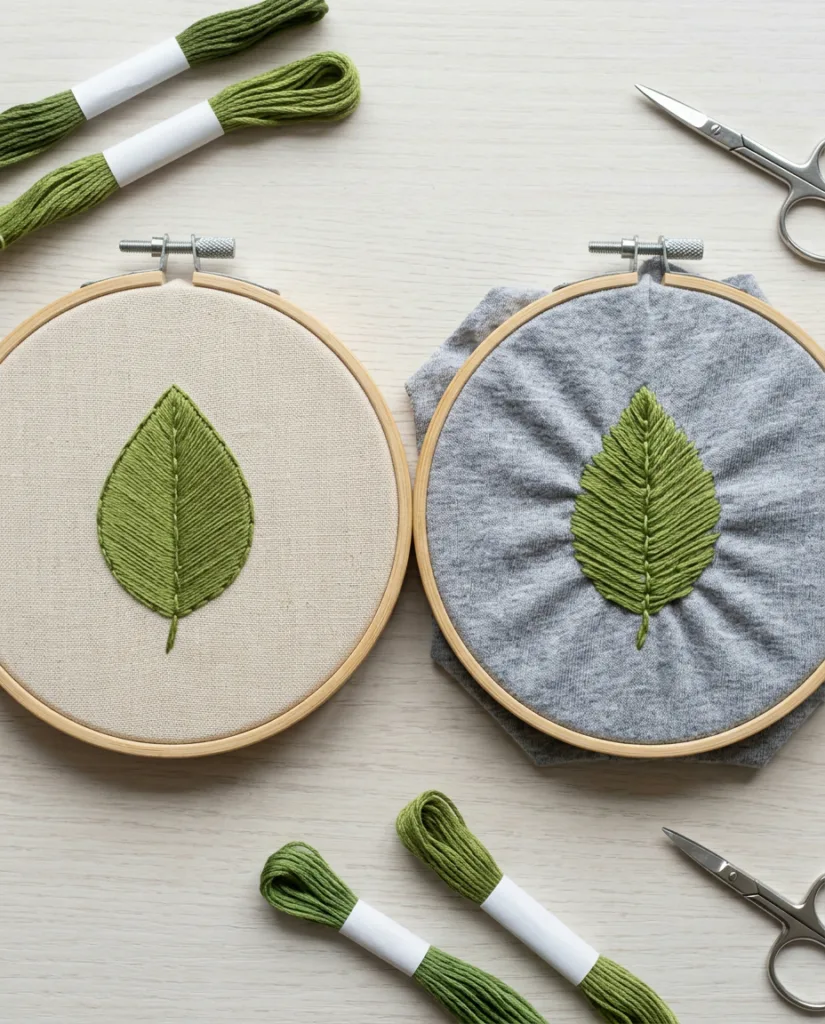
This is the fabric to leave alone at first. T-shirt jersey stretches as you hoop it. So does anything with elastane (spandex) in it. The stitches get worked into fabric that is pulled bigger than its resting size. When it relaxes, the thread doesn’t, and the fabric bunches up around it.
 Save
SaveKnits can be embroidered. They just need a stabilizer, a support layer attached to the back that stops the stretch. That is a second skill to learn once the stitches themselves feel steady. Wait until then.
Weave and weight, in plain numbers
Hold a fabric up to a window. If you can see light through clear gaps between the threads, it is an open weave. Tight weaves look solid.
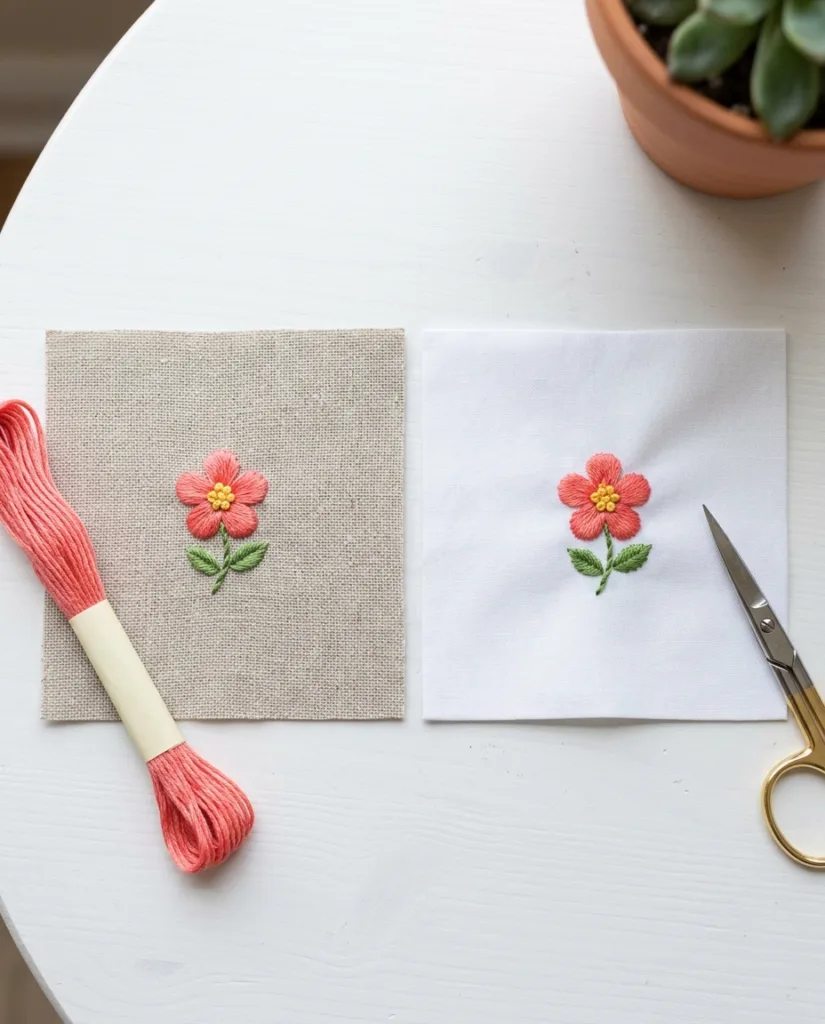
But open weaves, like most linens, need care. Small stitches can sink between the threads. French knots vanish through to the back unless the needle goes down one thread away from where it came up. Stitches shorter than about 2 mm (under 1/16 inch) can slip into the gaps and disappear. Use 2 or 3 strands and stitches of 3 to 4 mm on linen, and the texture works for you.
Tight weaves, like quilting cotton, give sharp, precise lines. Lettering and fine outlines look cleaner on them.
 Save
SaveWeight is the other half. Under about 4 oz, fabric is too thin to carry stitching alone. It shows every thread on the back and puckers under fill stitches, so it needs a backing layer. Over about 10 oz, a regular needle is hard to push through, and small hoops struggle to close on it. The easy zone for hand embroidery sits between 4 and 7 oz.
Pinch-test too. Crush a corner in your fist for five seconds. Fabric that comes out deeply creased will crease inside the hoop as well, so press it well before hooping.
Heavy fabrics need a bigger needle
Denim and cotton canvas both take hand embroidery well. They are so stable that they rarely pucker. The challenge is force. A size 7 needle bends or leaves you with sore fingertips on 12 oz denim.
Switch to a size 3 to 5 embroidery needle, or a size 22 chenille needle, which is sharp with a large eye. Use 3 strands of floss so the stitches don’t disappear into the heavy weave. Keep stitches 3 to 5 mm long. A thimble on the pushing finger helps more than any other tool here.
 Save
SaveHoop size changes too. Heavy fabric grips better in a 5 or 6 inch hoop with a wrapped inner ring than in a small one. Garments add their own rules about seams and pockets, which the guide to embroidering jeans covers. Check the label first, though. Denim with 1 or 2 percent elastane stretches, and it needs a stabilizer like a knit does.
Felt sits apart from every other fabric here. Its fibers are pressed together without any weaving, so it never frays and needs no hoop. Stitch it in your hand with 2 strands and a size 7 needle. Wool-blend felt holds up far better than thin acrylic craft felt, which stretches and pills. Neither kind likes a washing machine. Wool blends can shrink and acrylic can fuzz, so keep felt for things that won’t be laundered.
Which fabrics need a stabilizer
Four groups need one. Knits of any kind are the first. Thin wovens under about 4 oz, like cotton lawn and voile, are the second. Silk and other slippery fabrics shift under the needle without one. And towels need a thin water-soluble film on top so stitches don’t sink into the loops.
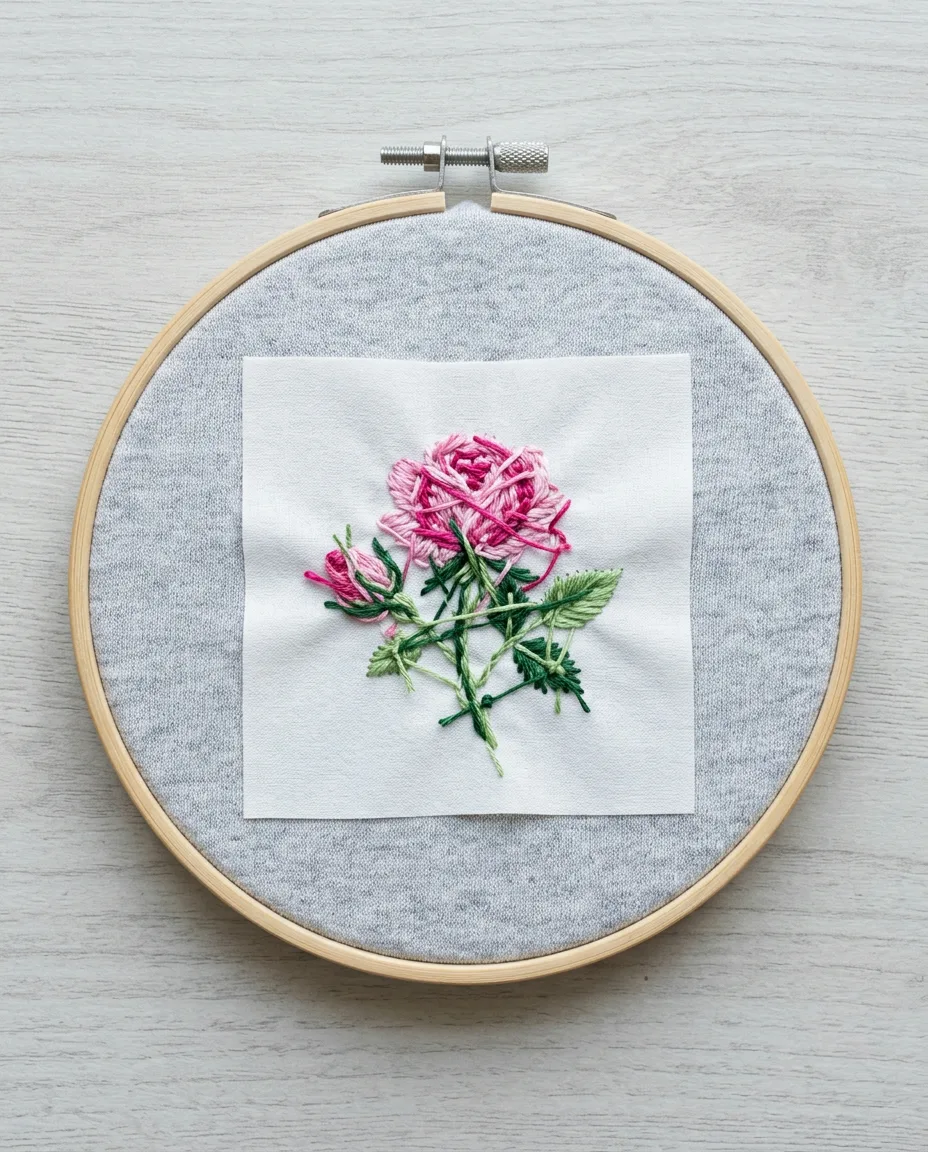
Stabilizers come in three kinds. Cut-away stays on the back for good and is the right choice for knits, because the fabric keeps moving for as long as it is worn. Tear-away pulls off after stitching and suits stable fabrics that just need a little extra body. Water-soluble dissolves in water, so it works on top of towels or as a stick-on layer for tracing a design onto dark fabric.
 Save
SaveFor a first T-shirt, use a lightweight fusible cut-away stabilizer, meaning one with glue on the back that irons on. Cut a piece 1 inch bigger than the design on every side and iron it onto the inside of the shirt before hooping. Follow the heat setting on the package, and keep the iron moving so the knit doesn’t scorch.
Counted fabrics are a different craft
Aida cloth is woven into a grid of small squares with a hole at each corner. It is made for cross stitch, where every stitch is counted and fits one square. On 14-count Aida, that means 14 stitches to the inch. Evenweave, often 28 or 32 count, is the finer version, usually stitched over two threads at a time.
Free-style surface embroidery on Aida works, but it looks blocky. Curves turn into steps because the needle keeps falling into the same grid of holes. If a pattern calls for smooth stems and petals, pick cotton or linen instead. For counted work, use a blunt size 24 tapestry needle, which slides through the holes without splitting threads.
Prewash, press, then hoop
Prewash anything that will be washed later. Clothes and tea towels shrink in their first wash, and cotton or linen can lose 3 to 5 percent. If that happens after stitching, the fabric tightens around the thread and ripples. Wash and dry it the way the finished piece will be cleaned.
Wall pieces don’t need a prewash. Press them instead, because a fold line pressed into the fabric is nearly impossible to remove once stitches cross it.
Then hoop the fabric until it is tight enough to sound like a drum when tapped. If a finished piece still ripples, the guide to why embroidery puckers walks through the six usual causes in order.